
Mobile zero-volt discharge technology supports flexible handling of changing lithium-ion battery formats and provides operational basis for next phase of capacity expansion.
BLC – The Battery Lifecycle Company GmbH and battery-recycling technology company No Canary have completed one year using No Canary’s mobile electrical battery-deactivation equipment at BLC’s Magdeburg operation, generating operational experience that is now being used to expand the site’s permanent discharge capabilities.
BLC is a joint venture of TSR Group and Rhenus Automotive and provides services across the vehicle-battery lifecycle, including repair, reuse and recycling. TSR Group is part of the Remondis Group. No Canary develops lithium-ion-battery recycling equipment and complete recycling-line solutions, including its Octopus electrically regenerative discharge platform to deactivate lithium-ion batteries.
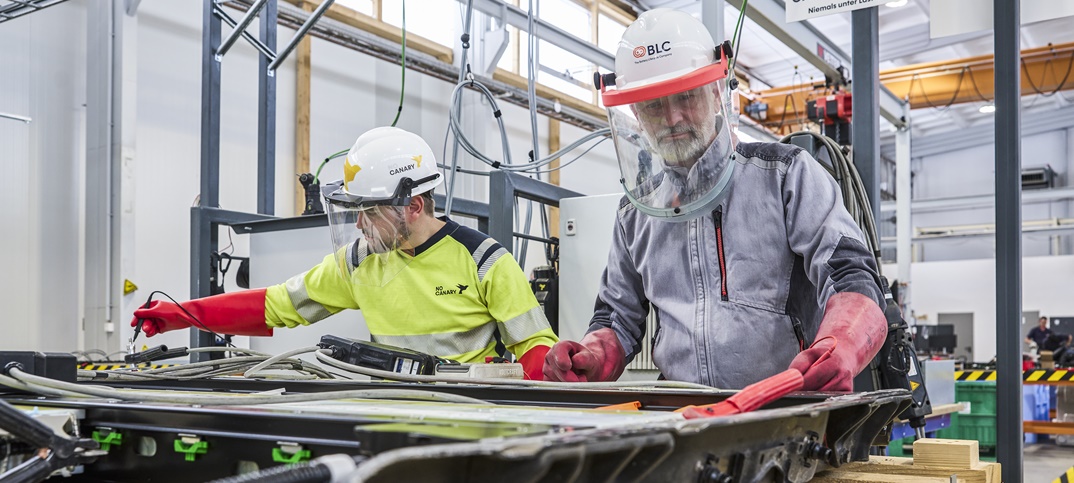
During the mobile deployment, No Canary technology was used to electrically deactivate lithium-ion batteries at BLC’s Magdeburg facilities. BLC has used two No Canary mobile zero-voltage-discharge units at the Magdeburg site since the beginning of 2025 and which together can deactivate around one tonne of lithium-ion batteries per hour.
The mobile No Canary configuration has 84 kW of discharge power, a 0–1000 VDC operating range, adjustable discharge current up to 100 A per channel and separately monitored discharge channels. The mobile installation incorporates data logging, current and voltage monitoring, reverse-polarity and overvoltage protection, thermal imaging and automated temperature-dependent discharge interruption, as well as automatic machine-side short-circuiting once the defined zero-voltage threshold has been reached. The unit can be repositioned with a pallet jack and the published mobile configuration requires only two separately fused 63 A CEE sockets.
The combination of discharge to zero voltage and subsequent controlled short-circuiting is significant because deactivation is more than conventional deep discharge. Current German standardisation work notes that a deeply discharged lithium-ion battery can relax and regain the ability to accept energy, whereas deactivation is intended to remove that capability before further handling and recycling.
“The rental approach gave us the flexibility to integrate additional discharge capacity into a working recycling environment and learn from a broad range of incoming battery. What matters to us is not simply nominal machine capacity, but safe, repeatable operation, flexible connection concepts and an efficient transition into dismantling and downstream recycling. The experience from this phase has given us a strong basis for the next step at Magdeburg”, states Lukas Brandl, Managing Director, BLC.
BLC’s Magdeburg operation is designed for heterogeneous battery flows. The facility has capacity of up to 15,000 tonnes per year and approximately 30 employees working in three shifts. BLC handles activities ranging from battery assessment and second-life evaluation to deactivation, dismantling, sorting and preparation for materials recycling.
“Mobile zero-volt discharge is intended to bring an industrial deactivation process to the places where batteries need to be deactivated. Working with BLC has allowed us to proof the technology with another great customer in full-throttle commercial recycling environment and feed that experience again into the next generation of the installation. The combination of monitored discharge, energy recovery and controlled short-circuiting is designed to give recyclers both flexibility and process transparency,” says Christian Hanisch, No Canary.
No Canary’s Octopus technology continuously monitors current, voltage and temperature and can detect anomalies in discharge curves. Its current product specification includes reverse-polarity, overvoltage and overcurrent protection, thermal monitoring, automatic short-circuiting, datalogging and OPC-UA connectivity. Recovered electrical energy can be returned to the facility network; No Canary specifies energy-recovery efficiency of up to 95 per cent for its discharge technology.
Source: No Canary GmbH