
The global textile recycling market is finally shifting to an industrial scale. For years, progress was stalled by a fundamental lack of synchronization across the value chain. Now, decisive policy action is providing the essential financial anchor needed to bridge this gap.
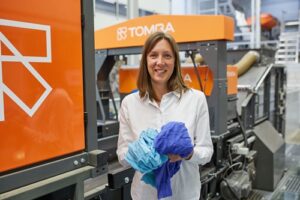
As Louisa Hoyes, Segment Director – Textiles at Tomra Recycling, highlights, the sorting technology is commercially viable and ready. The key challenge now is overcoming the deep disconnect between automated sorting capabilities and market scale.
The textile industry is at a pivotal point due to rapidly intensifying global regulations. This movement is led by key developments like the new European Union EPR scheme, which ensures producers are financially responsible for the full lifecycle of textiles, and France’s new Ultra-Fast Fashion Bill, which introduces an escalating eco-tax of up to Euro 10 per item and mandates eco-score labeling. These European measures, often viewed by countries like the US and China as setting the pace, highlight the sheer volume of textile waste – millions of tons annually – and the new reality of the mandatory EU separate textile collection, which came into effect on January 1, 2025.
The global textile recycling market faces an immense challenge: EU collection is now enforced and the financial weight of EPR is looming, yet the industry remains markedly immature compared to established streams like plastic or paper. Today, less than one per cent of annual textile waste is recycled into new products without being downgraded [1]. However, industry analysis suggests that scaling fiber-to-fiber recycling could boost the global recycling rate to over 30 per cent, unlocking a raw material value exceeding US Dollar 50 billion [2]. This shift is expected to create a profitable, self-standing industry, with the European recycling value chain alone estimated to generate an annual profit pool of up to Euro 2.2 billion by 2030 [3].
From technical feasibility to industrial viability
Tomra recognized this immense hurdle early and over the past decade has been dedicating resources to textiles development. The real priority is now accelerating the synchronization and industrial scaling of this complex value chain, a process where Tomra’s decades of expertise from other established material streams provide a significant head start. We are no longer debating feasibility; we are addressing industrial viability.
The core challenge in textile recycling is not if we can sort, but how fast and how purely we can recover materials for fiber-to-fiber recycling. Textiles present a vast degree of heterogeneity: garments are composed of countless complex blends, multiple fabric layers, dyes and non-textile components such as zippers and buttons.
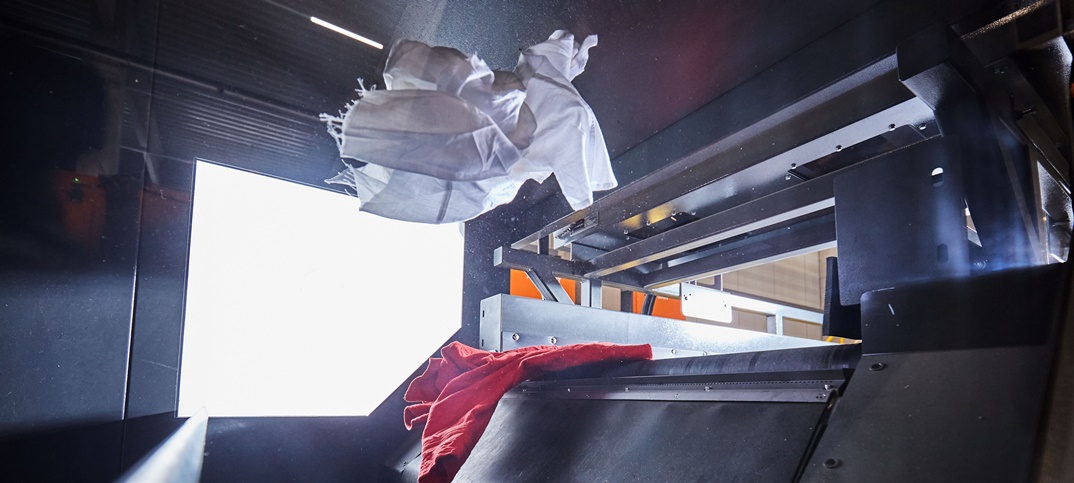
Our solution for all complex sorting tasks (including whole, cut or shredded garments) is the „Autosort“ unit. Its core strength is its multifunctionality, providing unmatched versatility in both material handling and sensor integration across various applications. The unit employs a combination of sensors: NIR (near-infrared for fiber composition), VIS (visible spectroscopy for color) and EM (electromagnetic for metal detection). This flexible and integrated sensor combination ensures the highest purity and enables optimal downstream processes for every feedstock. To maximize purity before shredding post-consumer clothing, we find it most efficient to sort the whole articles first prior to shredding.
The A/B sorting concept and the need for purity
Tomra’s A/B sorting concept – refined over more than three decades across industrial recycling streams like plastics and metals – offers a proven blueprint for scaling textile sorting. Unlike low-volume line sorters, Autosort is designed for high throughput, targeting one pure material fraction (A) while allowing all other materials to drop (B). This singular focus ensures the purity required by chemical and advanced mechanical recyclers, and the system enables a throughput of up to 4.5 tonnes per hour. For customers needing multiple fractions, cascading Autosort units – each leveraging advanced sensor integration – enable precise recovery of all desired materials from the infeed stream.
Sorting alone isn’t enough. To meet recyclers’ strict input requirements, Tomra has been working with Vecoplan, a leader in shredding technology, to deliver a complete solution. This integrated concept covers the full pre-treatment process: from advanced sorting and contaminant removal (like zippers and buttons) to size reduction and purification. Together, we eliminate a major barrier to scale – ensuring customers can deliver high-quality, recycler-ready feedstock.
Overcoming complex coordination
So, if textiles sorting technology is commercially viable and ready, why isn’t the market already scaling? The answer lies in the financial and logistical fragmentation of the overall market ecosystem. The sheer volume of waste – exacerbated by the low longevity of fast fashion garments – requires simultaneous action across five domains, relying on these key market drivers for a scaled circular textiles value chain:
1. Regulatory push: This includes the EU mandatory separate collection of textile waste (introduced on January 1, 2025) and a strong textiles Extended Producer Responsibility (EPR) scheme (mandatory by April 2028) to fuel cross-value chain investments. This is set to be complemented by forthcoming mandatory recycled content targets for brands under the Ecodesign for Sustainable Products Regulation.
2. Access to feedstock: Attaining sustainable prices through increased collection rates, creating new collection routes dedicated to both reuse and recycle-grade textiles.
3. Recycling technologies maturing: In parallel with sorting and pre-sorting capabilities scaling, this will enable textile-to-textile (T2T) recycling. Demand for fiber-to-fiber and downcycled products (e. g., non-wovens) brings waste percentages down, improving overall financial attractiveness.
4. Brands unlock ‚real demand‘: Brands must commit significant volume of off-take for recycled T2T material, driven by strong EPR schemes and minimum recycled content targets – such as those currently being discussed by the EU Commission under the ESPR Textile Delegated Act.
5. Increased consumer awareness: Acknowledging the real cost of fast fashion and a sustained shift in consumer attitudes towards reuse and repurposing.
A circular value chain for textiles is now emerging as key industry players begin to shape this new ecosystem. While Europe is leading the legislative push, the shift toward textiles as a strategic material is a global trend. This change is driven by brand sustainability goals, consumer demand and anticipated regulation in key markets like the US (California) and Australia, where similar circular economy discussions are gaining momentum. Consequently, waste managers and handlers worldwide are expected to scale rapidly as regulatory frameworks mature and off-take routes are secured.
Policy as the necessary anchor and call to action
Initiatives like France’s Ultra-Fast Fashion Bill signal that global regulatory patience has run out, validating the urgent need for synchronized investment across the textile value chain.
Governments globally must rapidly adopt effective EPR systems for textiles. Without this financial anchor (already established in the EU and emerging elsewhere), the entire recycling structure stalls. The bottleneck – the lack of a strong business case for sorting centers – will only be removed when brands commit to long-term off-take agreements for recycled materials, which are often channeled through the financial security of these EPR schemes.
The blueprint for industrial sorting and pre-processing is complete

The good news is that the technology debate is over. The blueprint for industrial, high-purity sorting and integrated pre-processing is complete. Policy acts as the catalyst, but the responsibility is shared across the entire sector. The time for brand owners, waste handlers and investors to stop waiting and start acting is now.
We have the equipment to supply the market and our commitment extends beyond current solutions to actively accelerate future market growth. The industry must now build the sophisticated, synchronized infrastructure to handle the volume and pull the material into genuine circularity.
Source: Tomra
[1] McKinsey & Company’s report: Scaling textile recycling in Europe – turning waste into value
[2] Boston Consulting Group (BCG)’s report: Spinning Textile Waste into Value
[3] McKinsey & Company’s report: Scaling textile recycling in Europe – turning waste into value